August 6-8, 2025 │National Taiwan University
by Paul Gabriel L. Cosme
The IASPM-SEA 2025 annual conference offered reimaginations of the notions of borders and peripheries in the context of Southeast Asian popular music. Held at the National Taiwan University in Taipei, the conference reconsidered Southeast Asia’s wider region geopolitics by highlighting the position of Taiwan as a space that negotiates the histories, soundscapes, and relations among cultures in Southeast and East Asia. Throughout the conference, scholars revisited historical formations of local genres, assessed strategies in utilizing music for both co-option and resistance, and conceptualized alternative analytical frameworks that centralize local ontologies and understandings of aesthetics and value systems in music.
The opening roundtable entitled “The Ebbs and Flows of Unease: Reflections on RE-/DE-/UN-centering from the Peripheries of SouthEast Asia” problematizes yet also presented opportunities for the reconfiguration of various ontological and geopolitical boundaries within and outside Southeast Asia. The ensuing discussions from the roundtable engaged the region’s evolving relationship with Western hegemony not only in scholarship but also epistemological underpinnings and their historical links. Major questions were raised such as: “how can we decentralize Western theories in analyzing local pop music?”; “with constant movement between peoples across Southeast and East Asia, what implications might this have in local identities and music-making?” and “what role does popular music have in how local subjectivities and resistances are formed?” These questions were broadly addressed in the various presentations over the following days.
The conference saw three emergent and interrelated themes from the panels and presentations: (1) hybridity, tradition, and innovation; (2) resisting and conforming state and colonial hegemonies and (3) resounding materiality, and labor through nostalgia and affective soundscapes. Issues of hybridity have long been a focal point for popular music studies and is prominent in Southeast Asia popular music. These developments continue to proliferate within Southeast Asia and beyond. Examples of papers that explored how traditions –– syncretized within regional and state boundaries were Gene Lai’s study on Tamil uṟumi mēḷam in Malaysia and how it evolved along with technological considerations and needs of the Tamil diaspora within Southeast Asia, Shura Taylor’s examination of the Puyuma mugamut dance celebration and its hybrid use of music from non-indigenous Taiwanese sources such as Kendrick Lamar and DJ YuanBryan, and Leonardo Garcia-Fuenzalida’s paper on the diffusion and hybridization of reggae across Southeast Asia and Taiwan. Collectively, the papers that highlighted hybridity chart not only aesthetic considerations but also historical developments in that hybridized genre such as Citra Aryandari’s paper on paradoxical consideration on dangdut koplo, Clare Chan’s study on Jelmol in Orang Asli slow pop rock, and Pei-Ling Huang and Madal Arik’s interpellation on ‘Amis romadiw and how it was mediated though generations and settler-colonial relations.
Many papers interrogated the complex relationship of music and the power of states. In common discourse, pop music, particularly rock and rap genres, is utilized as a means to express discontent and protest against local state influences and coercions, but also how the state may use popular music to solidify their hegemony. Examples included papers that dealt with Myanmar’s evolving political and military situation in Tasaw Lu’s examination of Gen Z strategies to use the digital landscape to echo protests, cross ethnic boundaries, and reach a wider global audience and Heather MacLachlan’s study on army songs in Myanmar and how they may be used as propaganda. Beyond the state, there were papers that highlighted s how music is used to protest interregional politics. Rebekah Moore’s examination of three cases (Azmyl Yunor, Gede Robi Supriyanto, and duo Filastine and Nova) concerning Southeast Asia exemplifies how protest can be amplified and reimagined across media and genres. The panel on the “Boundaries and Borders of the Hong Kong Indie Music Scene” explored the intricacies of the connections between Southeast and East Asia especially when it comes to the punk rock and indie scenes. The papers in this panel highlighted a constant collaboration and movement between the two regions (broadly Southeast Asia and Hong Kong/Taiwan) while strategizing to overcome state policies on censorship and immigration restrictions on movement.
Discussions on pop music are also associated with how materialities (CDs, instruments, concerts, fan paraphernalia) manifest affect, trigger nostalgia and evoke sentiment. Papers that broadly touched on such issues were Jeremy Wallach’s discussion on how the fluidity of digital platforms are eroding the material solidity (CDs, cassettes, and vinyl records, etc.) of subcultural music and are challenging existing business models in Southeast Asia, particularly Thailand and Indonesia. Tan Sooi Beng’s paper on inaudibility explored how popular music has emerged in the West but gives voices or audibility to lower classes in colonial Malaya. Huang Yung-Hsin’s paper explores the challenges and struggles of Indonesian migrant workers in Keelung and how they navigate being away from home by mediating these feelings through Indonesian songs. Guo Qiuyang explores how shidaiqu helps in constructing an ideal homeland and evoking Chineseness among Chinese Malaysians.
A recurring theme that emerged from the conference is the influence of “Chineseness” in popular music given the large Chinese migrations to Southeast Asia over the centuries. Questions that arose: is the prime connection between these two regions the rooted history of China in both East and Southeast Asia? Or is it the increasing elucidation of the (constructed/reimagined) Austronesian connections as amplified in Taiwan? Another strategic consideration that was raised among scholars was: what does it mean to host a Southeast Asian conference in Taiwan? Who among our peers are afforded access to the East Asian region amid issues of immigration and economic considerations? Future iterations of IASPM-SEA have these questions to grapple with as the region continues to evolve not only in the realm of popular music but also in many other fields, notably geopolitics, technology, and indigeneity.
Connections summarizes the ethos of this recent IASPM-SEA conference. While this report focuses on the intellectual undertakings of the participants, one cannot deny the strongly evolving camaraderie and diversity of thought, academic rank, gender, and generations of our peers and colleagues—sharing spaces in panels, meals, and social gatherings. This strength appears as a means for artistic and intellectual collaborations, which hopefully bring a resurgence of local epistemologies in understanding Southeast Asian popular music.
Notes from Formosa: My Participation at the IASPM-SEA Conference 2025
Francis D. Yumul (recipient of a travel bursary from an anonymous donor)
I have always associated Taiwan with its old colonial name, Formosa, and with the 17th-century Chinese general, Koxinga. In the early 1600s, Koxinga captured Formosa from the Dutch and used it as a base to challenge Spanish Manila. Meanwhile, the island is also known as the first settlement of Austronesian peoples, who began migrating southward around 3000 BC, eventually reaching the Philippines, maritime Southeast Asia and spreading across the Pacific. These layers of history—military, colonial, and ancestral—have long shaped my imagination of Formosa, and they set the backdrop for my own journey there.
I finally experienced the “Formosa” of my imagination when I attended the IASPM-SEA conference, held from August 6 to 8, 2025, at National Taiwan University in Taipei, themed Peripheries, Margins, and Ambiguities Across Borders in Southeast Asia. There, I presented a paper on the social realities and struggles of Filipino musicians in the local gig economy, tracing their evolution from pre-Hispanic ritual and community traditions, through church-based systems of the Spanish period, to today’s platform-mediated freelance performances. My research explored how these shifting forms of engagement have shaped musicians’ livelihoods, artistic identities, and labor rights in contemporary Philippine society.
Among the interesting moments I observed at the conference was hearing presenters from other countries, such as Malaysia and Hong Kong, acknowledge the subtle influence of Filipino musicians and bands within their own cultural narratives — performing, and at times even recording, intercultural melodies. This recognition reminded me of the long history of Filipino musicians as transnational performers, part of a diaspora that has stretched from the 19th century to the present.
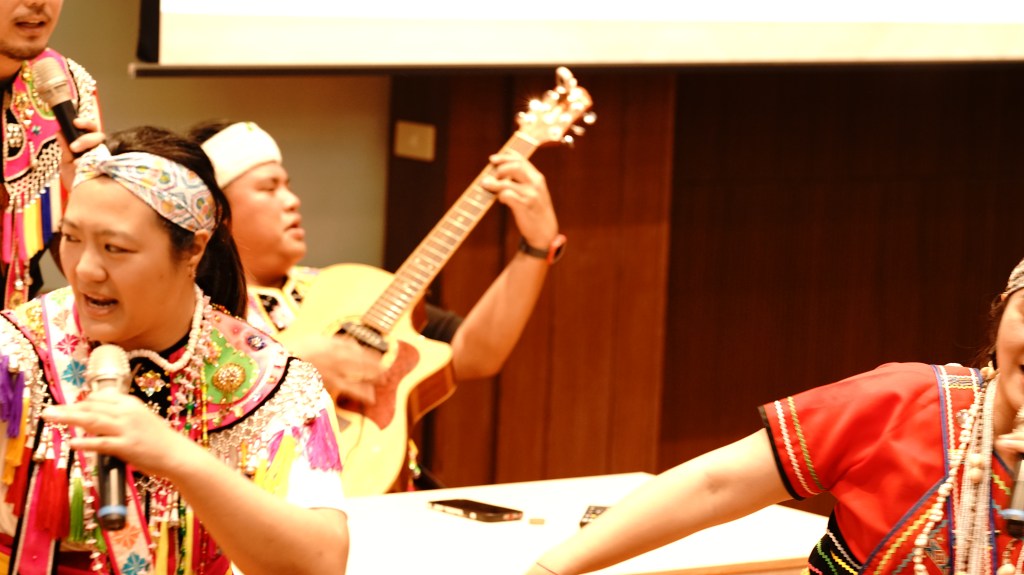
One of the highlights for me was listening to a performance rendered by the Amis people, one of Taiwan’s indigenous groups. Their singing immediately sparked a sense of kinship with the cultural minorities of the Philippines, whose traditions, languages, and mannerisms feel remarkably familiar. What captivated me most was their crisp diction and the way they pronounced vowels — so strikingly similar to the patterns found in many Philippine languages, an audible hint of the deep historical and linguistic connections shared across these Austronesian communities.
I must also mention the presentations by my fellow Filipino participants, many of which also reflected the social values and challenges we face in our country. Yet, despite these discordant themes, there was a shared sense of positivity within the group, demonstrating the common Filipino trait of striving to contribute not only to the success of the conference but also to its uniqueness.
Finally, what stays with me most are the friendships made, the talks and conversations shared, plus the atmosphere of scholarly exchange and camaraderie that such gatherings foster. I left Formosa already thinking of new research to pursue, eager to return to another conference of this kind.
 iaspm-sea.org
Leave a comment